Prep and Go Checklist: Thoracocentesis

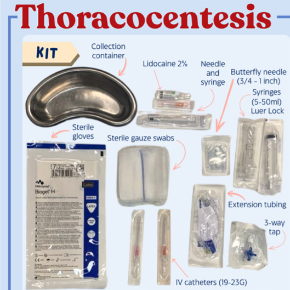
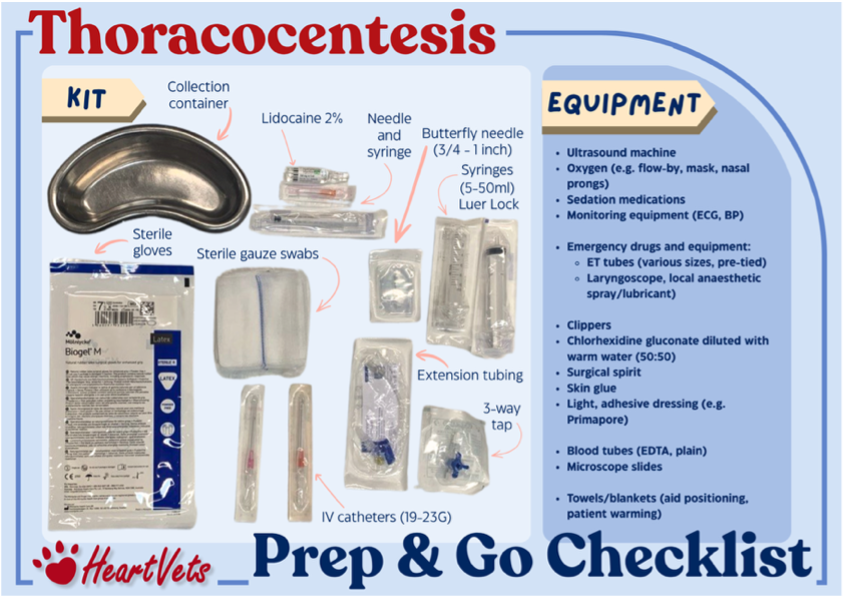
Part of a diagram showing a variety of items needed for a Thoracocentesis kit

Our Prep and Go Checklists (emergency kit lists) are designed to help teams quickly gather everything they need, saving valuable time and reducing errors in critical moments. Veterinary nurses are perfectly placed to lead their use — coordinating care, anticipating needs, and keeping everything running smoothly. These resources are free to download, print and share with your whole team.
Download now


TOP TIPS: Thoracocentesis

KIT (to use alongside our Prep and Go Checklist)

  • Prepare a grab-and-go emergency kit in advance, accessible to the whole team
  • Ensure emergency drugs and equipment (e.g. endotracheal tubes, laryngoscope) or crash box are ready
  • Set up oxygen supplementation where required
  • Prepare monitoring equipment (blood pressure, ECG etc.)
  • Have warming aids available

PATIENT

Before

  • Minimise handling – gentle restraint is key
    • Remember: in dyspnoeic patients, less is often more
  • Position in sternal recumbency or sitting to optimise ventilation
  • Consider light sedation (e.g. butorphanol) to reduce stress and facilitate intravenous access
  • Clip and aseptically prepare the thorax (uni- or bilaterally), typically between the 7th–9th intercostal spaces
    • In calmer patients, clipping and initial preparation before sedation can save time

During

  • Expect a rapid improvement in respiratory rate and effort as fluid or air is removed  
  • Immediately report any deterioration — complications can include pneumothorax or lung laceration

After

  • Close monitoring of heart rate and respiratory rate/effort is essential during recovery – changes may indicate recurrence 
  • Apply a small adhesive dressing to the site; consider providing a spare for owners  
  • Mild leakage from the site can occur post-procedure – warn owners to avoid unnecessary concern

Download our Thoracocentesis kit diagram


Read More