
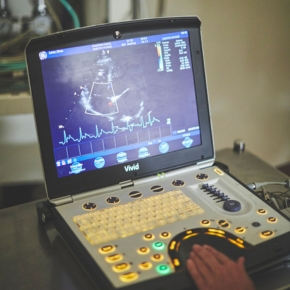
4 Reasons to Book an Echo Course this Autumn/Winter
From clinical confidence to career development, echocardiography is a skill that keeps on giving. Choose from our three upcoming courses to suit every level.

We get it – for many owners, the cost and complexity of mitral valve repair surgery means it simply isn’t a realistic option – even with insurance or fundraising. But it’s not the only surgical intervention available.
It is important that we are able to discuss the full range of treatment options with owners, so that decisions are made with informed consent and realistic expectations (in line with RCVS guidance). A third interventional palliative treatment option is now available: trans-catheter edge-to-edge repair (TEER) of the mitral valve.
TEER is performed using a V-clamp device, which clips the mitral valve leaflets together to reduce the volume of regurgitation. The device is introduced via a catheter through a small thoracic access point, with placement guided by transoesophageal echocardiography.
Compared with open surgical repair, this approach is significantly less invasive. Hospitalisation can be as short as two days, and several referral centres in the UK now offer the procedure, improving accessibility and reducing waiting times.
As with all interventional options, patients must be carefully assessed for suitability by a cardiologist. Ongoing rechecks are required post-operatively to monitor device position, residual regurgitation, and overall clinical response.
The most significant risk is detachment of the clamp device – typically occurring within the first 48 hours of surgery. Even partial detachment can result in sudden death or rapidly lead to severe and fatal congestive heart failure signs. Other complications are similar to mitral valve repair surgery – haemorrhage, thromboembolism, infection, significant residual valve regurgitation and anaesthetic related issues.
Published data from the Royal Veterinary College report that approximately 95% of patients survive to discharge. Two-year survival following TEER is reported at around 80%, (compared with approximately 90% for surgical mitral valve repair and around 15% for medical management alone in dogs with stage C disease).
Most patients continue to receive pimobendan following TEER, but many experience meaningful improvement in clinical signs and quality of life. Some may be able to reduce or discontinue certain heart failure medications, depending on their post-procedure response and disease progression.
TEER is not a replacement for surgical mitral valve repair, and it is not appropriate for every patient. However, for selected dogs where repair surgery is not feasible, it can offer a valuable palliative option beyond medical management alone.
If you have a patient where you feel options may be limited, early cardiology input can help clarify suitability, realistic expectations, and timing. We are always happy to discuss cases, provide initial cardiologist assessment and can advise on whether referral for surgical treatment may be appropriate.
From clinical confidence to career development, echocardiography is a skill that keeps on giving. Choose from our three upcoming courses to suit every level.

We offer a variety of learning opportunities throughout the year – now’s your chance to let us know what, where and how you want to learn.