
Owner resources
Once your vet has requested an assessment by one of our cardiologists, we will contact you directly to arrange an appointment at your most convenient clinic, depending on how urgently your pet needs to be seen.
Initial consultations are in the mornings and any procedures such as heart scans or ECGs will usually be performed the same day.
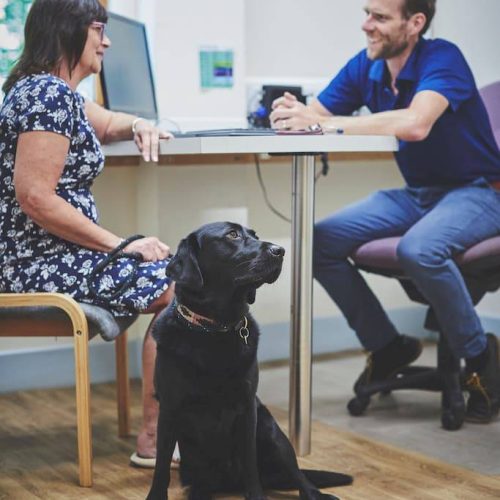
The cardiologist will review the case details and any additional information from your vet, and then sit down with you for a consultation which typically lasts around 30 minutes. During this time your pet will be examined and the options for investigation and potential treatment will be discussed, along with an estimate of cost for any procedures.
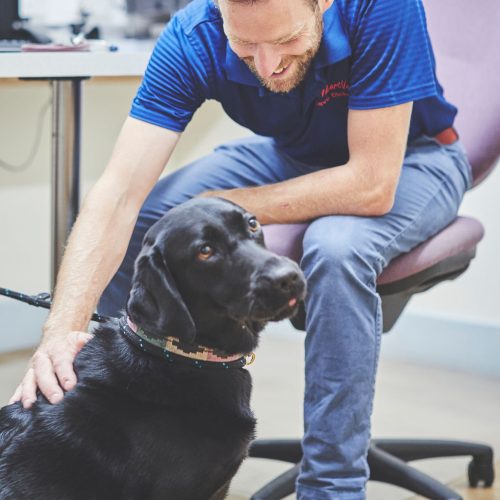
Most patients will require an ultrasound scan (to look at moving pictures of the heart beating) and/or and ECG (recording of the electrical activity of the heart). Both tests are non-invasive and usually performed without sedation.
When you return to collect your pet later that day, the cardiologist will discuss the results of any tests, and form a plan for ongoing treatment and monitoring. We will then provide both you and your vet with a written report of our findings and treatment recommendations. We will update you with any further results (e.g. blood tests) as they become available.
Read our FAQs
Below are some questions which are frequently asked by owners before their appointment:
Do I need to starve my pet before the appointment?
Yes, it is best not to give them breakfast on the morning of the appointment, unless a small amount of food is needed with medication. Water can be offered as normal. Although many of our patients do not require any sedation, feeding may also interfere with blood test results so is best avoided.
Should I give medication on the morning of the appointment?
Yes. Please give medication as prescribed your vet, unless this has been specifically advised against by one of our cardiologists.
Will my pet have hair clipped?
Hair clipping is usually necessary, although for cardiac ultrasound scans this is usually minimal. Further hair clipping may be needed for Holter monitoring (wearing a portable ECG monitor) or abdominal scanning/ blood tests.
How long will it take?
The initial appointment is usually around 30 minutes and then your pet will be admitted to the clinic for a few hours at least. Therefore it is best to plan to stay locally for the day, or arrange to come back for an appointment in the afternoon for test results.
What will my pet's investigation and treatment cost?
It is usually possible to give you an approximate estimate before your appointment, however the cardiologist will be able to more accurately discuss costs of investigation after examining your pet. Fees are payable on the day, to the clinic where your pet is seen. If you have pet insurance then the insurance company will reimburse the cost to you and we will complete the appropriate forms without additional charge. In some cases a direct payment by the insurance company may be possible but this must be agreed by prior arrangement. Please let us know if you would like more information regarding payment or insurance claims.
Watch our videos of a typical day spent with HeartVets
Information sheets
Below are some useful links and leaflets for owners with pets affected by cardiac or respiratory disease.
These leaflets and guides are provided for veterinary professionals to use in practice and for pet owners to download and print for their own personal information. All information, wording, images and design remain the intellectual property of HeartVets and must not be reproduced, adapted, rebranded or used in other publications or materials without prior written permission from HeartVets.
Owner guides
a useful way for owners to monitor their pets for development of congestive heart failure.
how to prepare a pet with heart disease for a trip away, including health checks, medication, what to pack and emergency planning.
a bacterial infection that can affect dogs and may cause reproductive, musculoskeletal and general health problems.
tips for keeping your pet's heart healthy, covering diet, household hazards, responsible breeding and regular heart checks.
what can cause collapse, what to do if your pet collapses, and what information will help your vet.
where to find trusted heart health information, including our owner resources, the EPIC trial website and the Cardalis app for tracking sleeping respiratory rate.
what an irregular heart rhythm is, what can cause it, and how we investigate it.
what a heart murmur is, what it might mean for your pet, and common causes.
Cardiac disease
a congenital condition causing a narrowing at or just under the aortic valve (called sub-aortic stenosis).
abnormally slow heart rhythms that can cause weakness or collapse and are treated with a pacemaker.
commonly occurs in older dogs which causes the main heart valves to leak.
Dilated cardiomyopathy or DCM is a heart muscle disease which typically affects large breeds of dog.
a heart muscle disease
a congenital condition where a dog or cat is born with a leaking or narrowed mitral valve.
a congenital condition where a blood vessel that should close shortly after birth stays open, putting extra strain on the heart.
a build-up of fluid around the heart, which usually requires emergency drainage.
a congenital condition causing narrowing of the pulmonic valve, which can lead to strain on the heart.
a congenital condition where a dog or cat is born with a malformed tricuspid valve.